CoLab: Building a Space for “Meta-collaboration”
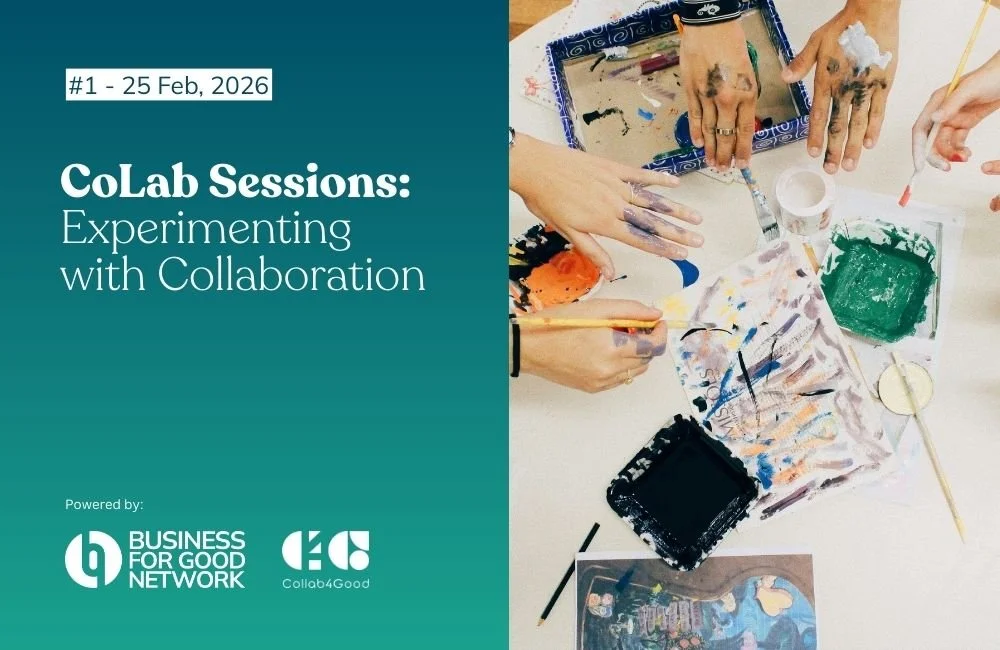
CoLab started after a collaboration masterclass by our partner Collab4Good, when something clicked for the group.
Everyone in the room was already collaborating. The missing piece was not another set of tools, it was a place to be honest about what collaboration actually looks like in real work, and what gets in the way.
So we organised a small online space to chat about collaboration, and called it CoLab. It is deliberately early stage. We are still exploring what we want this space to look like, and inviting people we think can help shape it and eventually own it. The aim is simple: reconnect regularly, bounce ideas around, share stories, and walk away with insights that we can actually integrate into our daily relationships, personally and professionally.
To make that possible, we aim to keep the container small and trusting. Invite only, lightly facilitated, no recording, and held with simple shared agreements, with any future public outputs shaped by feedback and consent. We also will not name attendees so everyone feels safe to share freely.
The first barrier: Time
Our first session was a very small group. That was not a failure, it was information. It reminded us that it is hard to make time for anything that does not feel productive straight away.
That observation opened a bigger conversation. In the world many of us operate in, productivity is the default setting. It is easy to stay stuck in doing. It is harder to stop, think, play, explore, and humanise relationships beyond transactional, results-oriented interactions.
Yet collaboration does not usually appear in a rush. It tends to grow through repeated, low-stakes moments: checking in, being curious, asking a question that is not strictly necessary, and making time for a conversation that does not have a neat agenda.
So yes, time is the first barrier. Not because people do not care, but because the culture around us keeps trying to convince us that relationship-building is optional.
If you are overwhelmed, collaboration becomes theoretical
The sharpest insight from session one was blunt and relatable: we cannot collaborate if we are overwhelmed.
When we are in reactive mode, with too much workload and not enough energy, we stop investing in relationships.
We start surviving tasks. And without the headspace to connect, collaboration turns into a word we like, rather than a thing we live.
This matters because most people in the business for good space are not short on values, care, or ambition. They are short on capacity. So the question becomes less “how do we collaborate better?” and more “how do we create the conditions where collaboration is even possible this month?”
CoLab is an experiment in those conditions.

A small ritual we want to keep: the pulse check
One of the most practical ideas we landed on was a pulse check at the start of CoLab days.
It is simple: do I have the energy today to connect around collaboration and be playful with ideas, or am I low on social energy and not in the headspace?
If you have the energy, you jump in. If you do not, you still protect the hour, but you step out and chill. You use the time intentionally for yourself: meditation, reading, journalling, or whatever helps you reset.
That tiny move does two things.
First, it treats collaboration as something that requires capacity, not just intention. Second, it normalises a mature kind of participation: sometimes the most collaborative thing you can do is not push through and become a drained version of yourself.
We have to be curious and playful, and it’s okay to have fun in the process!
A big theme in our notes was curiosity. Not as a buzzword, but as a genuine collaboration tool.
Curiosity is what keeps us playful. It lets us enjoy the process of bouncing ideas, switching topics, and letting serendipity take us somewhere we did not expect to find a solution. It is also simply fun to share ideas and play in self-exploration, and that playfulness builds connection.
Sometimes you just… “sit around and be curious”. Until you find the right people to collaborate with at the right time.


That matters for founders, funders, and impact leaders because so much of collaboration is timing. You can meet the right person too early, when you both have no capacity. You can also miss them entirely because you were racing from one commitment to the next.
CoLab is trying to create a rhythm where curiosity has somewhere to land.
Are we all on the same page about what collaboration means?
We talk about collaboration a lot, but often we are talking more than doing. Over time, words lose meaning when we do not live them, or when we each carry a different definition without realising.
So we should start asking basic questions that are not basic at all:
What does collaboration mean? What does connecting mean? What is trust? What defines a collaborative person?
A practical takeaway emerged: define the language around collaboration more consciously. Connect, collaborate, trust, alliance, partnership. Get clear on what you mean, so you can actually align expectations and avoid slow, avoidable friction.
For anyone leading in the business for good space, this is a quiet superpower. Clarity on language makes it easier to name what is happening, especially when things start to wobble.
Connection = Trust x Time
Another line from our notes landed hard: connection is rooted in trust over time, and building trust start with respect, honesty and authenticity.
That framing is useful because it makes connection feel less like networking and more like a basic human practice. Respect looks like listening properly. Following through. Acknowledging constraints. Making it safe for someone to say “I cannot take that on” without being punished for it.
We also captured a simple causal chain: collaboration is a consequence of building trust.
Trust takes time, energy, and intention, because collaborative relationships are built between people, not logos.
Often, the relationship-building happens before any formal collaboration is even on the table, sometimes without an intention to collaborate at all, and that tends to lead to better collaboration later.
Which brings us to one of the most grounded ideas in the whole session.
Coffees as collaboration
It feels both funny and true: coffees as collaboration.
Not every collaboration starts with a partnership agreement. Some start with a coffee where you realise you trust how someone thinks. Or you feel respected. Or you finally say out loud what has been bothering you about a project. Or you discover you both care about the same problem, but from different angles.
Those moments do not look impressive on LinkedIn. But they are often the real infrastructure underneath partnerships that later look “strategic”.
Is collaboration compatible with a competitive environment?
Let’s be honest, in the impact ecosystem, competition is real. Funding pools. Tenders. Attention. Talent. Even impact stories. The question is not whether competition exists. The more useful question is what it does to our behaviour, and whether we can still collaborate without becoming guarded or performative.
But, can we collaborate with someone who is not values-aligned?
We did not try to force a tidy answer. But we did name a pattern: when values are not shared, trust becomes harder, and collaboration can break down.
That does not mean “only collaborate with people exactly like you”. It means being honest about what values are non-negotiable for a given relationship, and what signals tell you the collaboration is heading into trouble.
Did this resonate with you? If you would like to join the next CoLab session, please send a DM to Javier Casanova or Arianna Watson.
Help us shape this space!
Join values-aligned people on Business for Good Network for the price of a weekly coffee!